What about quenching in helium?

With the increasing demand for LPC, it is crucial for the choice of equipment whether to quench in a gas stream or into oil. And if in a gas stream, then in nitrogen or helium. From the point of view of feasibility, this is clear. Nitrogen, even if we use 20 bar, has limited hardenability in steels of the 16MnCr5 or 20MnCr5 type. There is only a certainty that 18NiCrMo6-5 steels will harden it reliably, probably also 42CrMo4 alloyed in the upper HH hardenability band. But others don’t have to. We have only two options. If we insist on gas, we must have helium. Otherwise, we have to choose oil hardening. But what about the costs?
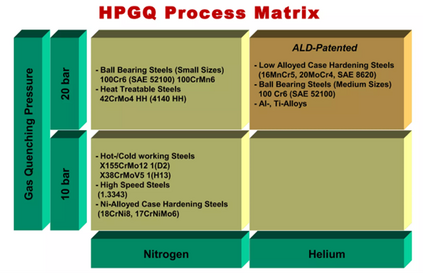
Fig. 1 – Feasibility of hardening in nitrogen and in helium for individual applications and materials [1]
To facilitate the calculation, I considered that LPC with gas quenching has the same acquisition value as LPC with oil quenching.
- What all processes have in common is that they need washing before the process. I considered the cheapest, i.e. washing in an alkaline bath.
- For nitrogen hardening, I took into account both the price of liquid nitrogen and the rent for accessories.
- For helium hardening, the cost includes the price of helium and the cost of recycling. In terms of investment, it is necessary to take into account that the gas recycling and purification station will cost us around 500 k€. Helium is used to have a purity of 99.5% with a content of about 3% hydrogen, 5 ppm O2. This can significantly affect the price of the cartridge. I calculated 30 €/m3.
- It is also complicated with oil hardening. The costs include both washing and filling and maintenance of the oil bath. But the type of washing also has a big influence. I chose two variants, an alkaline water washer of the Ipsen WPSD type and a Downclean 1601 modified alcohol washing machine.
The difference can be seen in the picture.
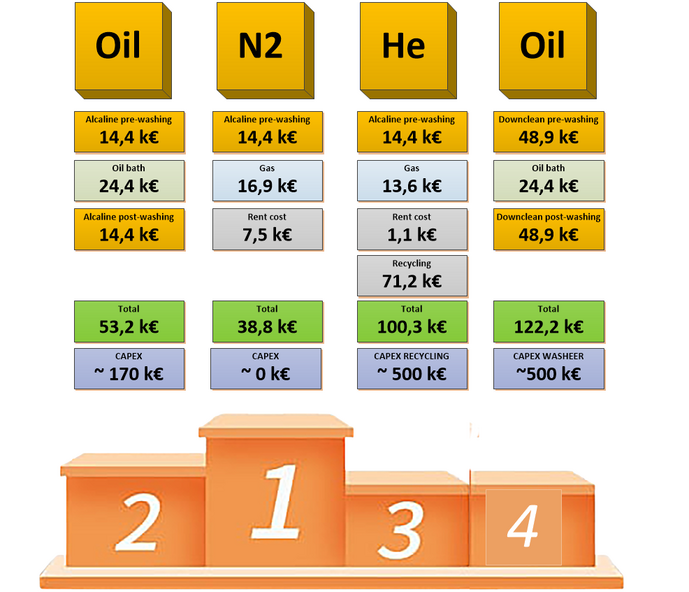
- Hardening into nitrogen costs us the cheapest. We do not need any investment costs, and the price of gas, even if we release it into the atmosphere after the process, is not significant. Total annual costs 38.8 k€.
- In second place is oil hardening with an alkaline washing. The total annual costs of 53.2 k€ also include the depreciation of the washing machine over a period of 10 years from the acquisition value of 170 k€.
- Helium came in third place with a total annual cost of 100.3 k€. These also include depreciation of helium recycling and purification facilities worth 500 k€ over a period of 10 years, of which the costs of gas recycling and purification make up 70% of the amount.
- The worst was the variant with oil hardening, but with the use of perfect washing in Downclean 1601. The washing machine itself has an acquisition value of more than 500 k€, depreciated over a period of 10 years. Thanks to the perfect, but energy-intensive washing, the costs will rise to 122.2 k€ per year.
Although the choice of technology will seemingly be determined by the cost of washing, in reality it will be more parameters. Hardenability, deformation, transferability from existing technology, etc.
What I was interested in at the beginning, i.e. the choice of helium or oil, does not have a simple solution. However, the analysis shows that if we have high demands on the cleanliness of parts after hardening, and we get hardenability, then helium is a better choice than perfect washing after oil hardening.
[1] https://www.slideshare.net/slideshow/high-pressure-gas-quenching/46400470
Jiří Stanislav
February 3, 2026