Giga casting a Giga dies III

From the previous blog, it is clear that even if the pioneer of the new concept of car production is Tesla and Elon Musk, in terms of localization, Asia, especially China and Japan, is the furthest in this technology. But how is it with the production of dies for these GIGA presses? And how will it be with Volvo in Košice at Slovakia?
If we have a classic tool room, we will not succeed with such dies. It is simply the difference between David and Goliath. The mould for GIGA presses can weigh up to 200 tons, the clamping plates for a 9,000-ton press are 4×4 m.

Fig. 1 – Giga Press IDRA with 9,000 Ton Clamping Force (https://www.teslarati.com/tesla-cybertruck-idra-9k-ton-giga-press-teaser-images-video/)
The price of a GIGA press with a clamping force of 16,000 tons is USD 18 Mio, the price of the mould is up to USD 4 Mio. The lifetime of the GIGA press can be estimated at 20 years, but the lifetime of the die is roughly 100,000 shots, i.e. 1 year. Therefore, if the car should look the same for twenty years, at least 20 duplicate dies will be needed during the lifetime of the press.
But is the lifespan of the mould for GIGA presses really 100,000 pieces? With the Tesla brand, it is noted that each GIGA press has two identical dies, always one mounted on the machine and the other in repair or maintenance. And since it is stated that the service life of individual insert can be 30 to 80 thousand pieces, then the maintenance requirements of such a mould will also be high. The economy of the GIGA factory can be partially seen in this video, but it seems misleading to me. If the cost of the die is USD 4 Mio and the lifetime is 100,000 pieces, then the cost per piece will be USD 40 and not USD 2 as indicated in the video. However, it can still be seen that the major cost item for GIGA castings is the material.
. https://youtu.be/5kX31zSoxlo

Fig. 2 – Breakdown of casting costs at the GIGA press
Interesting information about how a tool room should look for such large dies can be found at this link.https://schaufler.de/en/new-production-hall-for-giga-dies/. Dies weighing up to 200 tons will be produced here, and for GIGA presses with a clamping force of up to 10,000 tons. The basis of all this is a crane with a load capacity of 120 tons and the spotting press up to 200 tons. The rest is just classic machining. But we can’t find anything about thermal processing here either.
So, what should the heat treatment look like for such large dies? What does Nadca 207: 2022 actually define for us? How to find the right quenching furnace? How temper? These questions are becoming common and I have to admit that I have been asked about it even from Japan. What does Nadca 207: 2022 say?
- The quenching furnace should have such cooling capacity that it is possible to achieve cooling rates of min. 28 C/min.
- The furnace should have cycle programming set up so that it can be fully automatically controlled from thermocouples Ts and Tc
- The furnace must be capable of isothermal hold

Fig. 3 – The ideal quenching cycle included in the CCT diagram
- The furnace should not be overloaded, the cooling capacity of the furnace must not be limited. It is usually recommended not to exceed 50% of the maximum batch weight. So, if we have a die insert weighing 1 ton, we have to look for a furnace with a capacity of 2 tons, etc.
- Hardening parts must have holes for Ts and Tc thermocouples prepared and defined. Without this measurement, there will always be doubts about the correctness of the processing
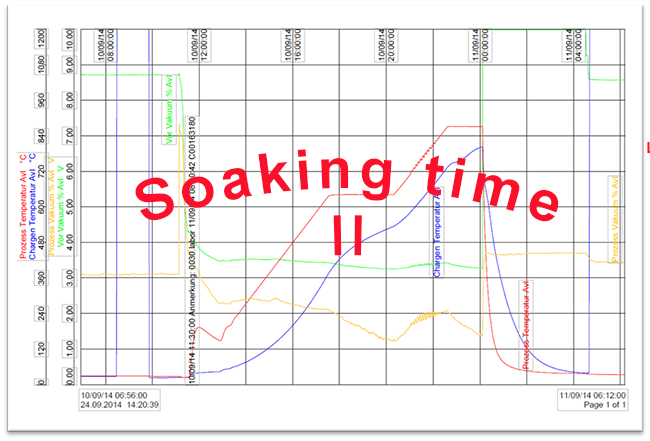
- Tempering in a quenching furnace carries the risk of underheating or multiplying operation times (see Fig. 4).

Fig. 4 – A typical example of the problem when tempering of large part is done in the quenching furnace, when the required temperature was not reached even after 16 hours of the process
- A tempering furnace with the same dimensions should therefore be available at the same time with quenching furnace. Nadca 207: 2022 does allow tempering in air, nitrogen or another protective atmosphere, but personally I would rule out tempering in air due to oxidation along the grain boundaries and surface decarburizing. Only if the entire surface of the mould is subsequently completely machined, with a removal of min. 1 mm, air tempering can be considered.
- The tempering furnace should be able to control the process from Tc
- The time of hold at the tempering temperature is 2 hours
- Hardening and tempering furnaces should have a valid TUS and These two tests say that the furnace has a guaranteed uniformity of temperature in the working space +/- 5 C (TUS test), and at the same time that the set temperature is also the actual temperature (SAT test)
As far as the Czech Republic is concerned, I believe that the only furnace that currently fully fulfils the above conditions is the TAV H8 furnace installed in Galvamet. However, with the fact that the furnace is designed for 1.5 tons, it is possible to safely process inserts up to 750 Kg. Since I personally participated in the programming of the furnace, I could vouch for this furnace that it meets all the requirements of Nadca 207: 2022 in terms of programming.

Fig. 5 – TAV quenching and tempering furnaces in Galvamet
In the next step, it depends on the designer how he divides the die into individual inserts. Their individual weight and shape will then influence the selection of the necessary furnace. If it will be like this, as shown in Fig. 6, we have to count on the fact that individual inserts can weigh up to 3.5 tons. So, we would have to look for a furnace with a cooling speed of 28 C/min and a load capacity of up to 7 tons.

Fig. 6 – Example of possible weights of inserts for GIGA presses
Is it realistic? E.g. TAV offers furnaces up to 3.5 tons, but larger furnaces can also be made to order, IVA Schmetz up to 7 tons, Ipsen USA Titan H8 furnace up to 1.8 tons, Chinese Fulcrum up to 10 tons, Systherms up to 2 tons, Fours BMI up to 2 tons, etc.
But it is clear that the size of the furnace itself is only one parameter. But we need a furnace that meets all the above requirements. And, of course, the chosen material of the insert plays a big role. Looking through the CCT diagrams of the steels listed in Nadca 207:2022, it appears to me that perhaps only Dievar is a suitable type of steel for these applications.


Fig. 7, 8 – CCT diagrams for H13 and Dievar
With all other steel grades, we will collide with the carbide precipitation curves and the formation of bainite.
There can certainly be someone who will come up with the claim, why not try it with only annealed material. That would solve the hardening problem. But even Nadca 207:2022 itself says that resistance to thermal fatigue is dependent on toughness, and only a martensitic structure can ensure it. If we were to use an insert not heat treated, then the ferritic-pearlitic structure will have 5 times worse resistance to thermal fatigue than the tempered martensite structure. So, the road doesn’t lead here.
As I mentioned in the last blog, the number of GIGA presses is gaining astronomical speed. So, I wonder who will join this game of MEGA or GIGA dimensions.
Jiří Stanislav
February 5, 2024