Grain size – is it a problem?

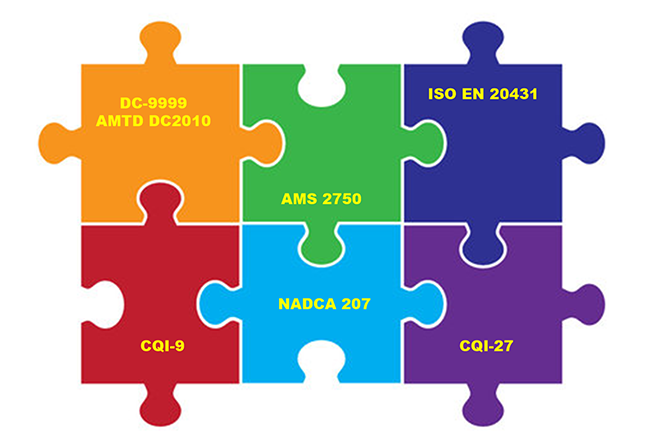
Hot work material applications to die casting dies require special control, as defined by Nadca 207:2025. It states:
Grain size:
- Grain size shall be developed using the Direct Quench method per ASTM E112 latest revision by austenitizing at the designated hardening temperature for 30-45 minutes, quenching at a moderate or rapid rate and tempering at 1100°F (590°C) minimum. Hardening should be in a protective media or by using an appropriately oversize sample in a non-protective media. Grain size to be measured by using the ASTM comparative method and shall be predominately ASTM No. 7 or finer.
- An alternative method to rate the grain size may be used. The Shepherd fracture grain size shall be predominantly No. 7 or finer when made on a hardened specimen, air cooled after heating for 30 minutes at the appropriate austenitizing temperature in a protective media (or using an appropriately oversize sample in a non-protective media) and untempered.
Page 17:
Grain Size determination should be conducted on a properly prepared metallographic specimen of a laboratory quenched and tempered sample in the etched condition at a magnification of 100X. Due to the typically fine grain size, examination may be made at a higher magnification using the formula presented in ASTM E112 (latest revision) Comparison Method.
Samples for evaluation of the hardened microstructure shall be made on a specimen taken from commercially heat-treated material and must include an as hardened surface, i.e. not ground or otherwise machined after hardening. Preferably, the sample should be taken from the hardened coupon used for impact toughness testing for Special Quality material. Alternatively, a sample may be cut from a corner or edge of a hardened workpiece of Special Quality material if no test sample was attached to the workpiece.
_______________________________________________________________________________________________________
This instruction can be followed exactly if the tool shop tests the input quality, and in that case, it has a test coupon, ideally hardened in oil and tempered twice. The same applies in a situation where a coupon is also available for testing the heat treatment performed. If there is no coupon, i.e. neither input tests nor tests after hardening are performed, then we have a problem, especially if the insert does not have the required service life, or if the die casting shop complains about it.
To evaluate the grain, we must therefore take a sample from the insert, if possible, from the place where cracks occur, but not from the surface where the material is already affected by the casting process. At the same time, we will check all records from the heat treatment and find out whether the process parameters were such that they would affect the input, purchased values of grain size.
We will prepare a metallographic section as standard. Tool shops usually do not have any equipment for this, so they must submit this analysis to a certified laboratory. But what happens if we receive a photograph of the section with grain emphasis? The laboratory, if validated for austenitic grain evaluation, has standards or reference images of the corresponding grain size available. It compares the structures on our sample with the standard and issues a statement. That is the end of its work.


Fig. 1 – Example from the E112 standard, grain size standard 3 at 100x magnification
Fig 2 – Example of image analysis of the Keyence VHX-7000 microscope for grain size evaluation
However, the laboratory may have a microscope with image analysis, and in this case it will use SW tools that evaluate the grain size themselves.
However, we can check the result from the laboratory ourselves. It is not that complicated when we know that the grain size 7 is approximately 31.7 µm. All we need is a ruler and a scale on the metallographic image – see Fig. 3. In this case, the user measured it on a microscope, but it can be done manually if we see a reference line for the length of 25 µm.

Fig. 3 – Grain size measurement on Keyence VHX – 7000
What does ASTM E112 or EN ISO 643 allow? Grain evaluation can be carried out by various methods, but mainly:
- Comparative method – with this method it is not necessary to count the size of each grain or the number of grains intersected by a line. The principle is to compare the sample observed under a microscope with a series of graded images of microstructures according to grain size. The possible deviation from the actual size is ± 1 grain size
- Planimetric method – the principle of this method is to count grains within a defined space, most often a circle. The number of grains in a certain area NA is used to calculate the grain size number G. The accuracy of such a measurement depends on the thoroughness of the execution and is estimated at ± 0.5 grain size
- Intersection method – determination of grain size using a test line that intersects a certain number of grains or grain boundaries. The grain size G is calculated from the size of the line and the number of intersected grains. The accuracy of this method is ± 0.5 grain size. The intersection method is faster, while maintaining the same accuracy of determination, than the planimetric method.
Layman’s evaluation using the planimetric method
On a metallographic image, for example, we create a rectangle of defined dimensions, in this case we chose an area of 100×100 µm. These are 4 lines of 25 µm according to the photograph. For the evaluation to be relevant, we must find at least 50 grains in the area. In this example, I found 49. However, for evaluation, we can use a circle of the same diameter instead of a square.


Fig. 4 – Example of planimetric grain size assessment
Fig. 5 – Example of the linear intersection method
For the calculation, we mark individual grains by category:
- N1 – number of grains inside the rectangle/circle, counted as a whole grain
- N2 – number of grains intersected by the border of the rectangle/circle, counted as ½ grain
- N3 – corner grains, each grain counts as ¼ grain
This is followed by the calculation of N, where we add up our finding in the photo.
- N = N1 + ½ N2 + ¼ N3 = 33 + 14/2 + 2/4 = 40,5
The area of the measured rectangle is 100×100 µm
- S = 0,1 x 0,1 mm = 0,01 mm2
Number of grains per mm2
- m = N /S = 40,5 / 0,01 = 4 050
Average grain diameter
- d = 1/ √2 m = 1/√2 4 050 = 1/63,63 = 0,0157 mm
Next, we look at table no. 4 of the E 112 standard, where we find the average grain size in mm. In this case, grain 9 has an AVG dia dimension of 0.0159 mm. What we see in the metallographic image is therefore a very fine-grained structure with a grain size of 9.
Layman’s evaluation using the linear intercept method
The intersection method evaluates the number of grains that are intersected by a straight line. For the result to be relevant, there should be more than 50 such intersections. An example of this method is shown in Figure 5.
Number of grains on the line:
- nx = x1+x2 +x3 +x4 +x5 + ½ x6 + ½ x7= 6
- ny = ½ y1 + y2 + y3 + y4 + y5 + y6 + ½ y7 = 6
- nz = z1 + z2 + z3 + z4 + z5 + z6 + ½ z7 + ½ z8 = 7
Number of grains on a line segment
- Nx = nx/Lx = 6/0,1 = 60
- Ny = ny/Ly = 6/0,1 = 60
- Nz = nz/Lz = 7/0,1 = 70
Average number of segments on a line:
- NL = √3(Nx*Ny*Nz) = √3(60*60*70) = √3(252 000) = 63,16
From Table 4, ASTM E112, Grain Size Relationships Computed for Uniform, Randomly Oriented, Equiaxed Grains, column NL, we determine the grain size to be 8.5-9

Fig. 6 – Table 4 header
or
- l = 1/NL = 1/63,16 = 0,0158 mm
according to the same table, column “Mean intercept”, grain size 8.5 to 9.
In both cases we came to the same result. But there is a problem. In Fig. No. 5 there is a grain of size 43 x 48 µm. If min. grain 7 according to Nadca 207:2025 has an area A (Average Grain Size) of 0.00101 mm2, then it should have a diameter of 0.0317 mm, i.e. 31.7 µm. A grain of 43 x 48 µm is therefore larger than the minimum and corresponds to size 6.
In the case of Fig. 3, however, we have a grain of up to 151 µm. This corresponds to grain size 2. How to deal with this fact? The standard says that the measurement on one cut should be 3, but it depends on the evaluator how he hits the right place on the cut. An example is Fig. No. 7, where the result of the grain evaluation on the Keyence VHX 7000 is from the same sample as we evaluated in the previous one, and it should be 8-9. From the evaluation a grain size value of 5.66 was calculated.

Fig. 7 – Grain size evaluation on Keyence VHX-7000, result 5.66
So, is the microscope software able to evaluate the grain with more accuracy than the layman’s method? Probably not, but it always depends on the evaluator what he wants to see.
Nadca 207:2025 says that the minimum grain size should be 7 according to ASTM E112. The average grain size from 3 evaluations on one sample will therefore decide. So, if several measurements result in a grain with an average higher than 7, then everything seems to be OK.
But the reality will be different. I found an interesting article on this topic. https://www.geartechnology.com/influence-of-grain-size-on-metallurgical-properties. Figure 8 shows a super grain in the middle of the fine grain structure and this grain was probably the main cause of the fatigue failure of the case-hardened gear. The longest dimension within the grain was approximately 250 µm, which was probably the length of the longest slip plane and was associated with high stress concentration due to the accumulation of dislocations. The article states:
- Small grain size increases yield strength, tensile strength, fatigue strength and fracture toughness. The analysis shows that
- Yield strength, tensile strength, fatigue strength and fracture toughness are “weakest link” phenomena, which are controlled by the largest grain size in the critical region of the gear tooth.
- The failure mode will depend on the location of the critical grain

Fig. 8 – Super grain at the point where the gear was damaged
Recommendations:
- The AGMA 923 grain size specification should be: 90% ASTM E112 No. 5-8 grains and no grain should be larger than ASTM E112 No. 3 and no grain should be smaller than ASTM E112 No. 9.
- Metallographic grain size inspection should be performed in all critical areas on a representative sample of the gear tooth.
- For failure analysis, metallographic inspection should be performed at the crack initiation location.
AGMA 923 is the Metallurgical Specification for Steel and Cast Iron Gears from the American Gear Manufacturers Association.
____________________________________________________________________________________________________
In this respect, Nadca 207:2025 is not entirely perfect, because it assesses the quality of the steel according to average values. However, if the steel contains such exceptionally large grains, this will certainly have an impact on the resistance to thermal fatigue, due to reduced yield and tensile strength, as well as reduced fatigue resistance.
In the case of my assessment of damage to die casting inserts, I believe that the structure comes from the centre of the block, where the forging is no longer so perfect and where these extraordinary formations can occur. If the customer were to perform input tests, these imperfections would be easy to detect, because they would certainly be reflected in lower impact strength values. However, since he does not perform input testing, his ability to prove this approaches asymptotically zero, and therefore he will have to bear all costs for defects and damage to the part he supplied. Knowing the heat treatment records, it can be stated that the heat treater is highly likely not responsible.
Jiří Stanislav
June 10, 2025