3D printing Ti6Al4V
At the Scientific Board, doc. Ing. Tomáš Čegan Ph.D. presented the results of research and development of Ti6Al4V 3D printing for applications in implantology within the NCK Mechanical Engineering. Our efforts to change the technological process for personalized implants bring a new perspective to the future.
On the one hand, the implant manufacturer, Prospon from Kladno, has already included HIP as a standard process step after 3D printing, and on the other hand, it has been proven that even with materials from 3D printing, the properties of the formed material can be achieved. However, the road to this is breakneck, which is why I am very happy that we have embarked on this with Galvamet and VSB, and that the results correspond to our original ideas.
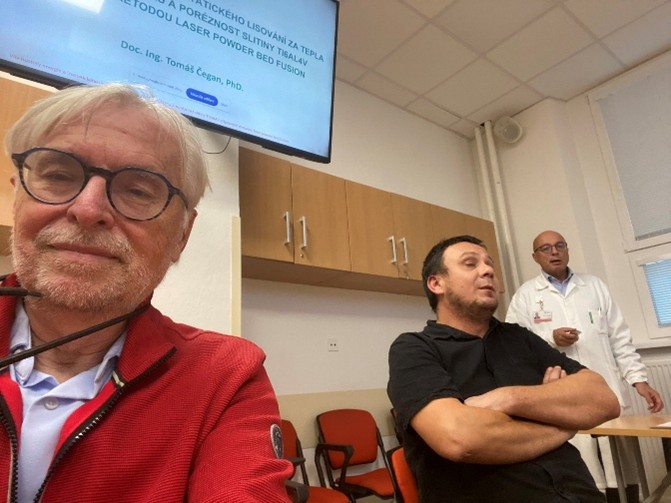
Fig. 1 – My little one, doc. Čegan and doc. MUDr. Pavel Douša, CSc., Department of Trauma Surgery and Orthopaedics, University Hospital Ostrava, Chairman of the Scientific Board of the Czechimplant cluster, in a discussion on the results of the project
And what are the biggest benefits of our research?
- Removal of microporosity in the body from 3D printing below 0.3% and increase in density approaching the density of the formed material
- Reduction of heterogeneity of the printing structure and increase of ductility and yield strength to the level of the formed material
- Reduce printing time by up to 60%
- Significant increase in implant fatigue properties
- Elimination of hidden defects
And if it wasn’t? Figure 2 shows a case where bone replacement was performed with an implant also made of TI6Al4V. Printing was carried out using the EBM method on an Arcam device. During the analysis of the causes of damage, it was found that the microcracks have initiation sites in the pores containing the working gas, and in places where the powder has not fully melted.
I cannot claim that this damage would not have occurred if we had used our procedure, but there would certainly have been a greater chance of survival of the implant. The analysis presented in this article does not show that any post-processes were applied after printing. This is also evidenced by the images of the fracture mechanism.
Because I have Garmins, I know that I walk an average of 8000 steps a day, i.e. 2,920,000 steps per year. This is therefore a case of highly cyclic stress, where it is necessary to count on at least 10 to 6 fatigue cycles. In the cited case, the implant ruptured after 6 months.
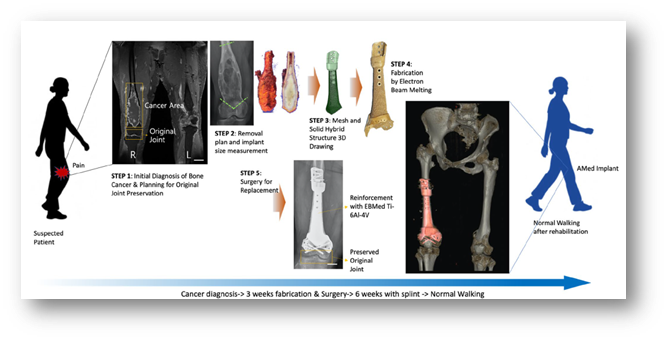
Obr. č. 2 Jong Woong Park, National Cancer Center Korea, In vivo analysis of post-joint-preserving surgery fracture of 3D-printed Ti-6Al-4V implant to treat bone cancer, Bio-Design and Manufacturing , July 2021 [1]
And how does it work out for us? The application of HIP significantly improves the yield strength and ductility of the materiál after 3D printing process. However, if further heat treatment is included, there will be a steep increase in fatigue properties. This is absolutely crucial for the lifespan of the implant.


Jiří Stanislav
October 11, 2025