Nato and heat treatment
It is interesting to observe how everyone is rushing into military production. But I’m not sure if they have any idea what they’re getting into. When I observe the pressures on process validation for aerospace, does it matter how we heat treat those parts for tanks, cannons, machine guns?
Well, of course, it doesn’t matter. But it works a little differently. There is no common platform for “military”, similar to AS standards. But there is an obligation
So what does it all entail?
- To perform a heat treatment service, you must have at least an ISO 20431 self-audit
- In addition to ISO/TS 16969, you must meet the CQI-9 for the processes in order to work for the automotive industry
- To work for the aerospace industry, you must have a mandatory AS9100, Nadcap Heat Treating approval. This means that you work with OEM Process Specifications (e.g. HT specs GE, Rolls-Royce, Safran…), AMS / SAE standards (e.g. AMS 2750), Nadcap checklists, Purchase Order requirements
- And in order to be able to produce weapons, you are subject to the state and its supervision in accordance with Act No. 309/2000 Coll. It says:
TITLE IV
STATE QUALITY ASSURANCE
§17
General provisions
(1) By means of state quality verification , the Office shall determine, at the request of the customer, whether the supplier meets the quality requirements resulting from the contract, namely whether the supplier
(a) the product or service conforms to the requirements set forth in this Agreement;
(b)the Supplier provides guarantees for the quality of the product or service set forth in this Agreement;
(c)The Supplier is able to meet other requirements set forth by the Customer in this Agreement.
(2) A Subscriber shall mean ministries, other administrative offices, regions, competent bodies of NATO, similar offices or bodies of NATO Member States or similar authorities or bodies of other States.
Competence of the Office in State Quality Assurance
§18
To ensure state quality assurance on behalf of the state, the Office concludes
(a) agreements on the recognition and implementation of state quality verification with the relevant bodies of NATO, similar authorities or bodies of NATO member states or similar authorities or authorities of other states, or
(b) agreements on the implementation of state quality verification for specific products or services with customers, unless the Office has concluded an agreement with them pursuant to letter a).
§19
(1) The Office is obliged to carry out the state quality verification at a supplier in the territory of the Czech Republic
(a) professional quality supervision (hereinafter referred to as “professional supervision”),
(b) final control of a product or service (hereinafter referred to as ‘final control’);
(c) quality audits,
if so stipulated in the contract between the customer and the supplier.
(2) The Office is entitled, on the basis of the customer’s request, to request a similar authority or body of a NATO member state or a similar authority or body of another state for state quality verification in the event that the product is manufactured or the service is provided on its territory and is purchased by the customer from the Czech Republic.
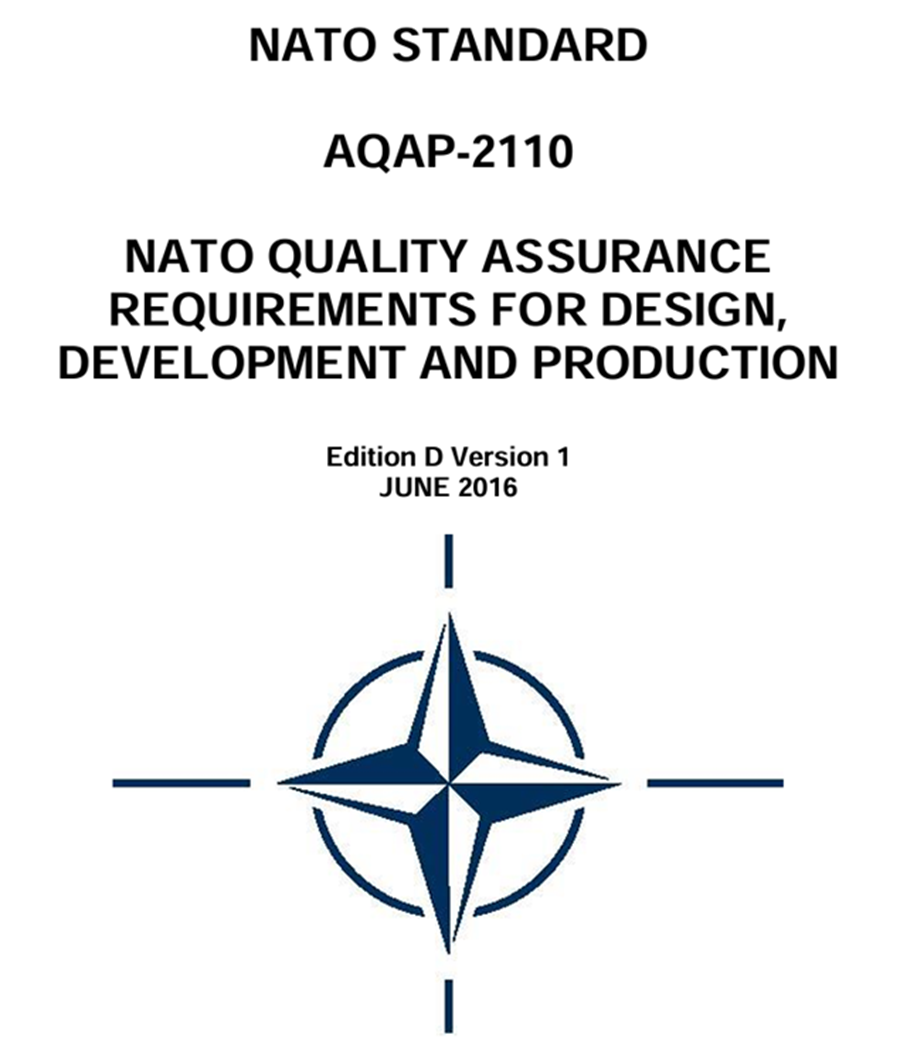
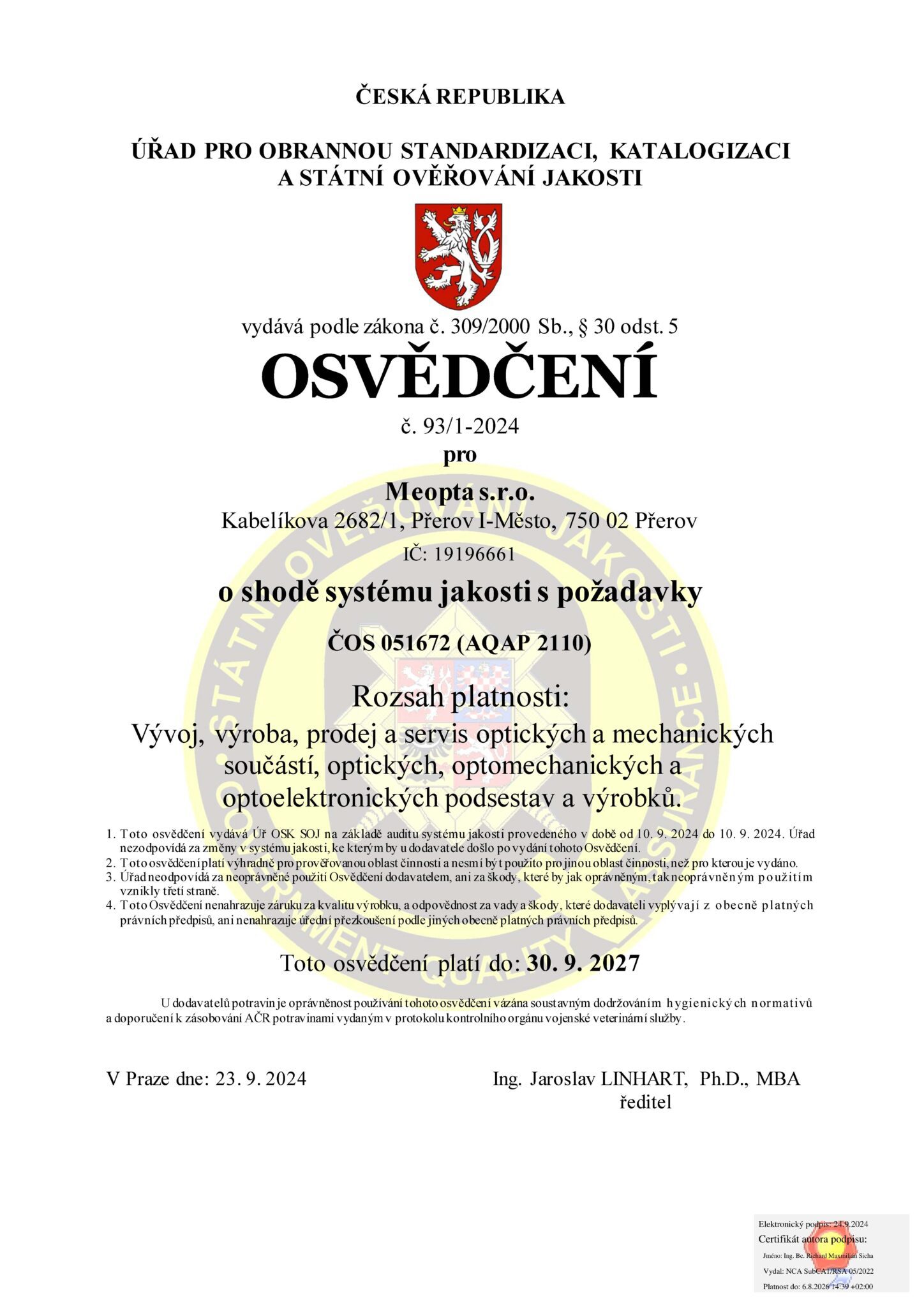
It follows that although we do not have a global “military” system as in the AS, in most cases we will be subject to NATO directives. There are AQAP (Allied Quality Assurance Publications) guidelines. Their implementation is not controlled by the PRI, but by the state. Although they are not certified, they are binding for compatibility reasons.
If there is a process approach to orders in the automotive industry, a safety approach for aviation standards, and a contractual and state approach for military production .
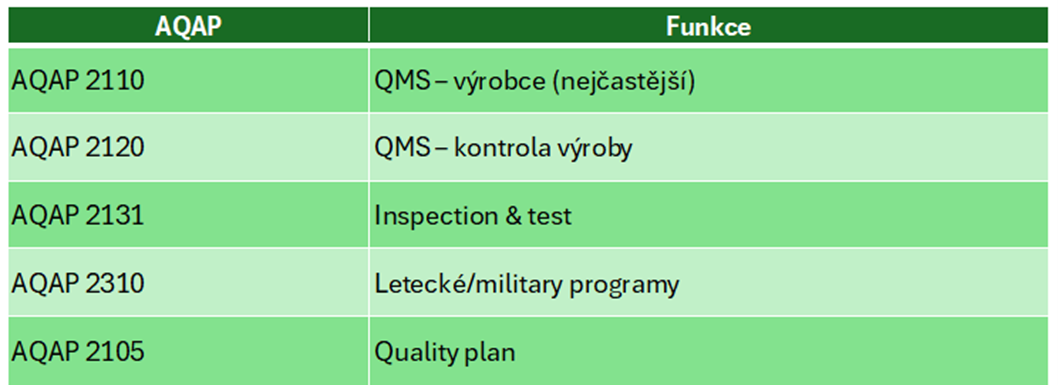
What does it entail? Our auditor is not the PRI , but the state. He has far greater powers than any other auditor. As part of the so-called GQA (Government Quality Assurance)
- has the right to audit production
- has secured access to the operation
- has access to records
- supervises the exams
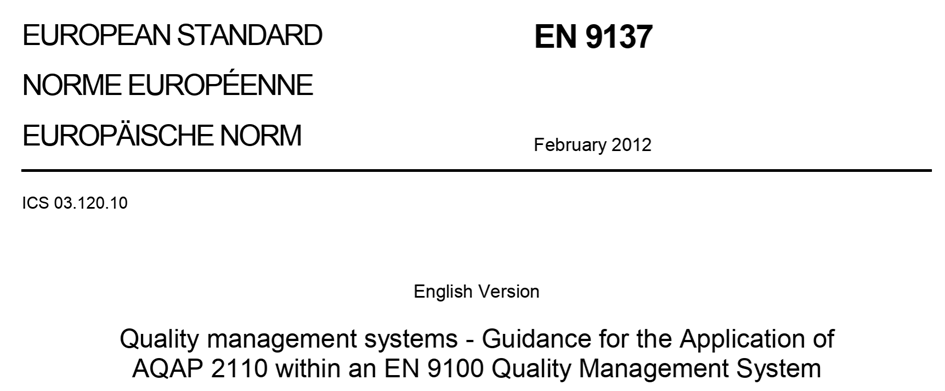
The basic condition is that we are not satisfied with just a quality system according to ISO 9001, but we must have AS/EN 9100. That is, the same level as the basis for aerospace. Only if we have one can we move on to AQAP 2110. To achieve this, there is a connecting bridge in the form of the EN 9137 standard, which is basically a guide on how to comply with AQAP 2110 based on AS/EN 9100.
This, of course, also has an impact on the heat treatment plant.
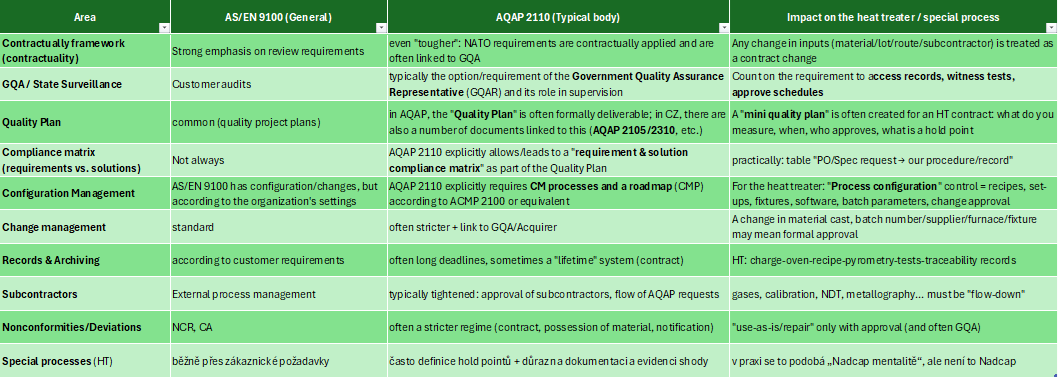
Virtually any violation of the terms and conditions is inadmissible, on the other hand, the terms and conditions must be detailed so that they are controllable. If the Nadcap auditor finds audit defects, he will give you a deadline to remove them, and after they are met, you will receive an order or you can continue with the existing contract. In the case of production according to Act No. 309/2000 Coll., you will lose the order. The significance of compliance with the agreed is even higher here than in the case of AS production.
What does it look like in practice?
=======================================================================================================
Are you solving a similar problem? I will help you with the analysis…
✔ 40+ years of experience in the field
✔ 30+ years of experience… HT-PROGRES, Bodycote, Galvamet
✔ cooperation… VŠB, Czechimplant, ECM Technologies, TAV Vacuum Furnaces, GHC Invest
✔ 12+ years of expert activity
Want to ask for a solution or want a non-binding consultation? Click on this link, I will usually respond within 24 hours. Contact email
========================================================================================================
Jiří Stanislav, Ing. CSc.
Consultant and forensic expert
========================================================================================================
May 7, 2026