Czechimplant or my way to doctors
Basically, I spent my entire professional life with heat treatment of metals, either in the form of research activities within the ZEZ Prague before 1989, or the practical application of these methods. First in our private heat treatment shop named HT-PROGRES, later under the heading Bodycote. There was never time for doctors. This profession was very distant for me, and if we were ever forced to meet, it was only to make my body box decay more slowly.
Last year, thanks to Mr. Šlechta and Galvamet, I was appointed to the scientific board of the Czechimplant cluster. What is it?
The basic strategy of the CZECHIMPLANT, z.s. cluster is to support the development of a significant medical field and provide members with optimal conditions for collaboration. The primary goal of the cluster is to facilitate collaboration among its members in the fields of research and development, and then introduce the results of that research and development into practice; including in areas that may be legislatively challenging for medical devices. Intensive mutual collaboration, support, and experience sharing can produce unique, innovative results within the industry with high applicability potential, especially in foreign markets.
An additional focus of the cluster is the effective use of all suitable means though which member activities can be supported, such as: grant programs for research and development; economic diplomacy projects to support member companies in penetrating new markets; support for cluster marketing activities; international collaboration development, including cooperation with foreign cluster organization, programs of a regional nature, and more.
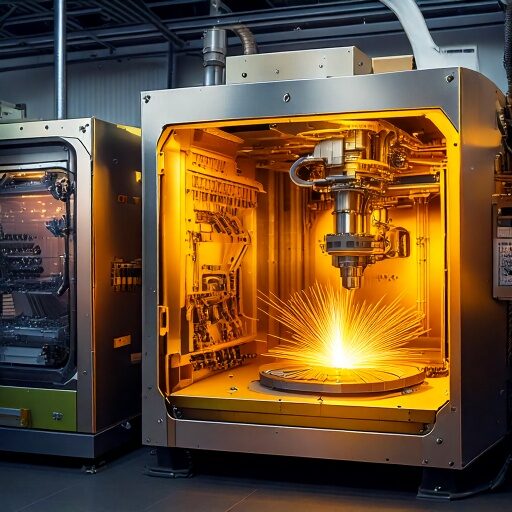
And how does my profession relate to that? Seemingly little, but in fact very much. If I omit everything that is outside my field, ie various bio materials, drugs, nano materials, etc. then today’s medicine is more and more tied to quality engineering in the production of various implants and body replacements, and thus to multidisciplinary cooperation between doctors and engineers. This is multiplied today by the advent of additive technologies and 3D printing, where the doctor presents his wishes in the form of data taken using CT (Computed Tomography) or MRI (Magnetic Resonance Image). However, experts specializing in data models, AM technology, materials engineering and, last but not least, heat treatment must take on another role.
From the supplied data, a so-called STL file must first be created, ie a data file understood by a 3D printer, and then a 3D model must be printed. Usually, plastic first. This is then used by doctors to verify that the model is suitable for the patient.
Only then is the data adjusted to a patient-acceptable version, and finally the final implant can be printed. That is, a piece that will be built into the human body. The choice of material is another scientific discipline. On the one hand, this material must be bio-compatible and on the other hand it must exist in powder form. These are usually titanium alloys (eg Ti6Al4V), CoCr alloys or stainless steels.
But that’s not the end of it. The joint replacement must also go through a heat treatment process. Firstly, so that the material after 3D printing acquires the necessary homogeneity, optimal structure, and secondly, so that it has adequate mechanical, especially fatigue properties. Few of us would like to repeat such a difficult operation just because the metal prosthesis will break. Here, then, is the importance of the role of materials engineering, and therefore heat treatment.
There is also a great responsibility. Everything is made to order, always only one original piece, and always in strictly controlled timing, because the patient already has an operation planned, or in the case of emergency medicine, there is no more time, because it threatens the patient’s life. In the first case, it must catch eg. one month, in the second, then needed a week, and on the first attempt.
The first meeting of Czechimplant on this issue took place in May, online, and focused on the topic of connecting the industrial, research and medical spheres in medical 3D printing. The second this week, on Wednesday, July 23, already with the physical participation of cluster members.
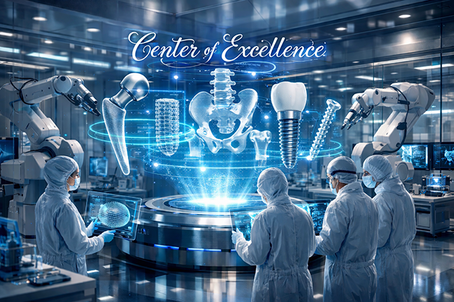
And what is the result? In addition to personal contacts with cluster members and top experts, the biggest benefit for me was the meeting with Mr. Čejka from ProSpon and our discussion on the topic of the Center of Excellence for Medical Applications. And what could it look like? It’s just my vision, but what if…

Fig. 1 – Idea of AM Center equipment for medical applications

Fig. 2 – An idea of the data structure and connection of hospitals with the AM Center

Fig. 3 – Influence of HIP technology on shortening 3D printing time (source Quintus Technologies, lecture by James Shipley, Association for Heat Treatment, Prague, 2019)

Fig. 4 – Influence of HIP technology on shortening of heat treatment time in Quintus HIP furnace (source Quintus Technologies, lecture by James Shipley, Association for Heat Treatment, Prague, 2019)
Only the last problem remains. Data between hospitals and the AM Center can be transmitted via 5D networks. But how to transfer own implants? Even that has its solution, perhaps even better today to say – a vision.

Fig. 5 – Vision or science fiction? Drone transport…
And what is the price for this vision? An estimated EUR 5 to 6 million. It’s too? E.g. in 2018, the price for health care in CZ was in the amount of 430 billion crowns, i.e. 17 billion EUR. Thus, the Center of Excellence for Medical Applications would mean a one-time capital expenditure of 0.0348% of the medical budget and its operation costs would be half that amount.
It makes sense? Definitely yes, if we think about the patient. Also, if we think about the concentration of production capacities and their economic use, we can only say yes.
And if we think of the transfer of the latest knowledge of science and research into clinical practice? Such a central workplace could react quickly to future changes. Just because it will hold internationally recognized certificates such as MedAccred, and in that case the validation of new processes will be significantly faster and more flexible.
28th of June, 2021
Jiří Stanislav